 w
w

|
Ten weeks on the Australian best-seller lists confirmed what teachers, librarians and students have long known: that Helen Chapman is a writer to be reckoned with. 101 Cool Science Experiments jumped the classroom walls and found its way into vast numbers of Australian homes. Parents as well as children delighted in the book: in its clear instructions, its intriguing experiments, and its humour. Most of all they relished not being talked down to. The quality of the information the book offered in its explanations of the science behind the experiments was outstanding. Even adults who had no direct involvement with children or with teaching bought the book for pleasure - and found themselves unable to put it down. As far as the younger readers of Helen Chapman's work are concerned, her books are loved for their humour and for their direct appeal. She says that her own children are her harshest critics. It is to them that she turns to test not only whether a narrative is working but also, and perhaps even more importantly, whether her choices of language and idiom are current. No manuscript leaves her hands until her children are happy with it. Helen Chapman's books have always been characterised by their deliberate
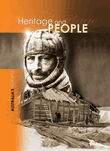
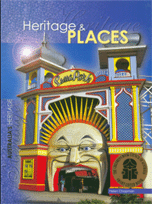
appeal to hesitant readers. As a private collector of first editions, she has the classics of children's literature always before her; and it is to their achievement that she aspires, while never forgetting the crucial importance, in today's world, of writing in an accessible way. With 90 books to her name, published in the United Kingdom, New Zealand as well as Australia, Helen Chapman is an established writer. Her range covers both fiction and non-fiction; her future she sees as one in which she will strive further to develop her skills, especially in the immediate and forceful communication to students and young people of her ideas and research via the printed page. 'The works which have given me the greatest satisfaction are among the most recent,' she reflects. 'The Australian Heritage series, commissioned by Heinemann, gave me a unique opportunity. Until that series was produced, there was very little available to children which could expose them to their historical and cultural heritage in an appealing way. To be able to demonstrate that their heritage includes not just old buildings, which don't necessarily attract young children, but items as exciting as Ned Kelly's armour and subjects as compelling as Don Bradman's sporting career, gave me great satisfaction.' The series is now available. On a more ‘four legged scale’, Helen wrote a magazine and monthly newspaper feature as a giraffe called ‘Harold’! Harold’ is the national figurehead for ‘Life Education,’ a comprehensive drug education resource at work in Australian Schools.One aspect of this involved reacting and responding in ‘character’ through her writing, to letters from primary school children. PublishersACER, Barrie, Five Mile Press, Ginn UK, Harcourt America, Harcourt UK, Harcourt Education, Harper Collins UK, Heinemann, Heinemann Library, Heinemann Primary, Hinkler, Macmillan, Macmillan Education, Macmillan NZ, National Geographic, Pearson Education Australia, Canada and UK, Rigby Reed Elsevier, Rigby Heinemann US, Rigby Reed Heinemann, Rising Stars UK, Wendy Pye NZ. |

|
||Home|| ||Books|| ||About Me|| ||FAQ|| ||Links|| ||Contact Me||